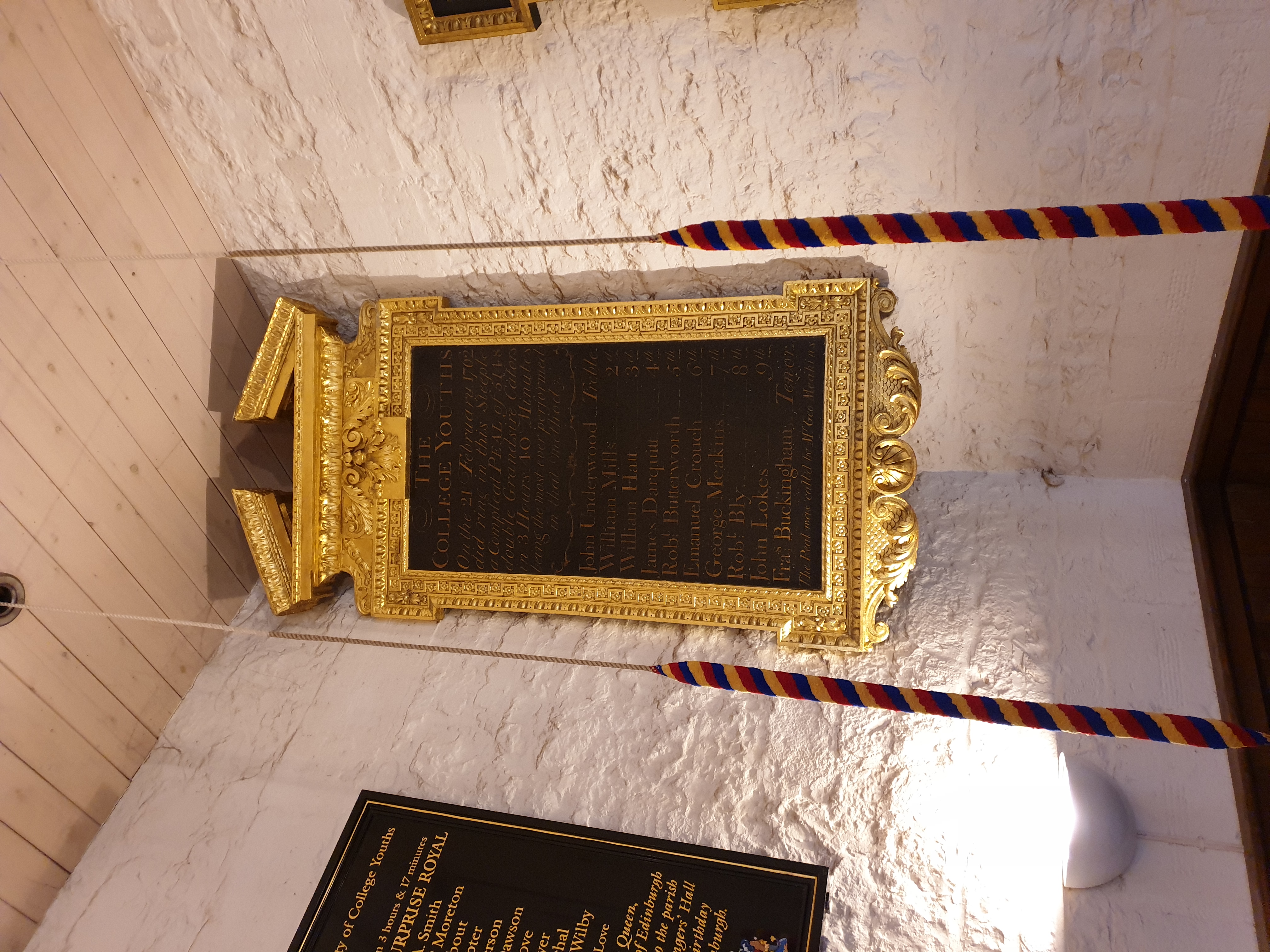
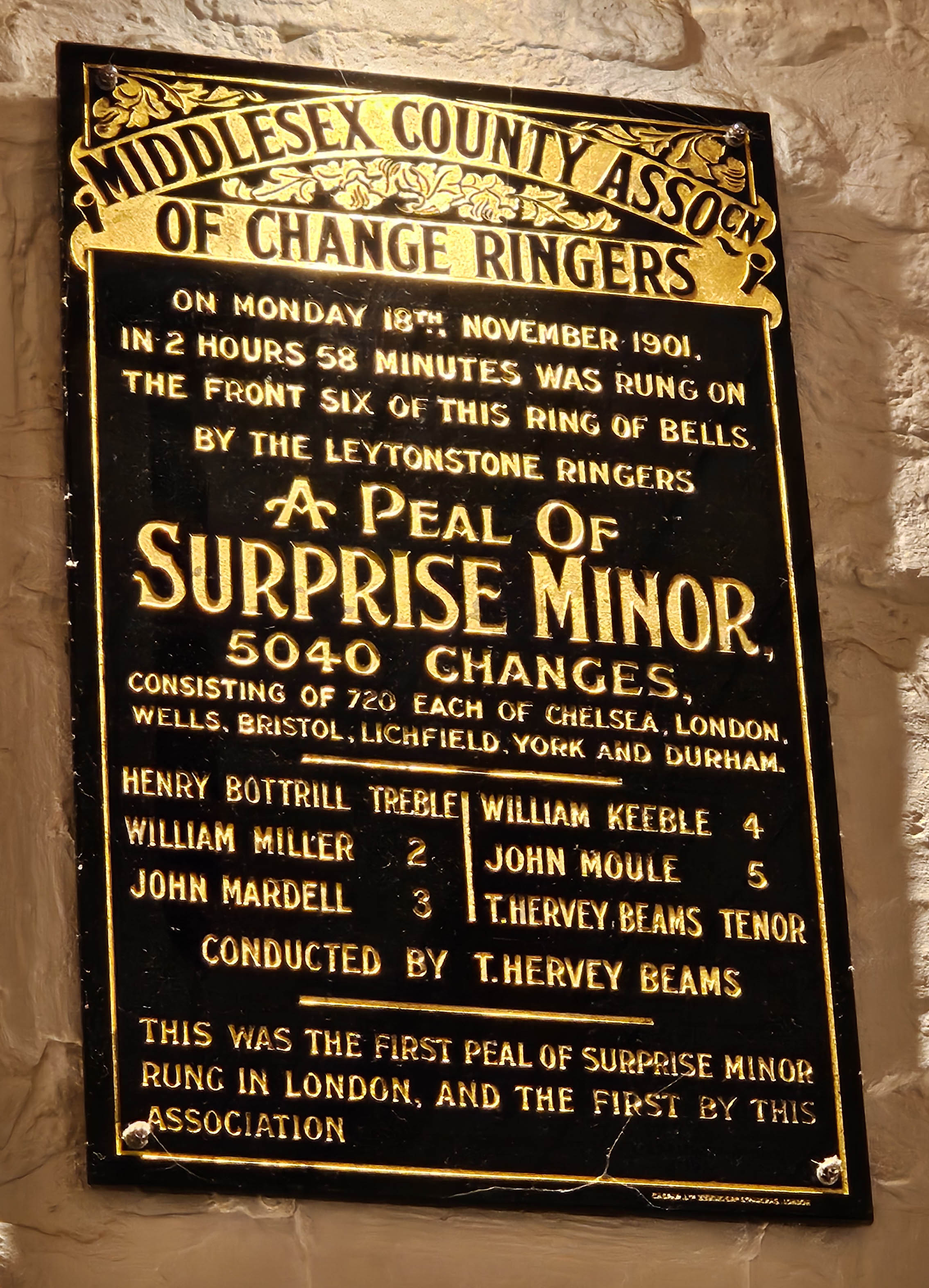
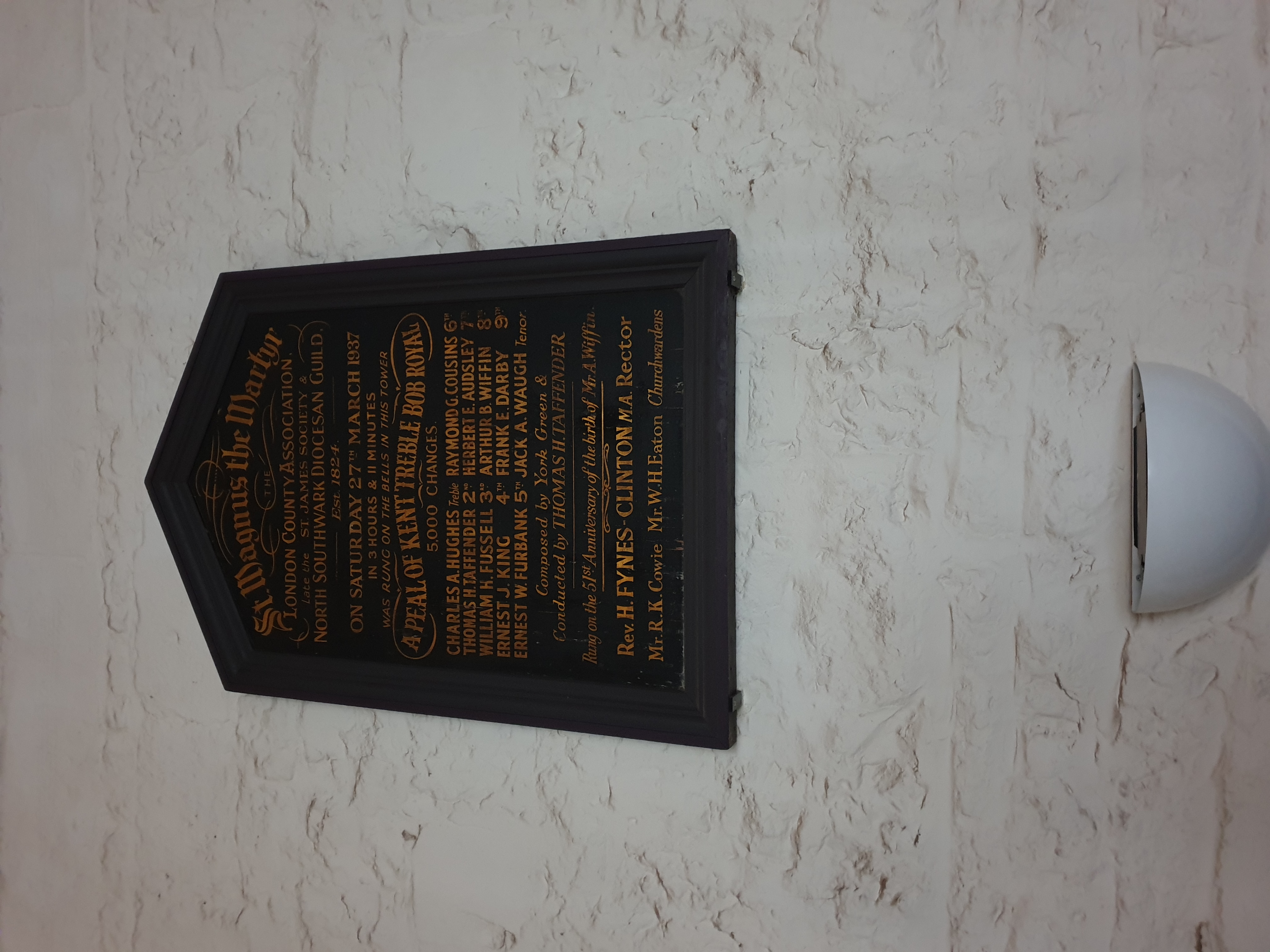
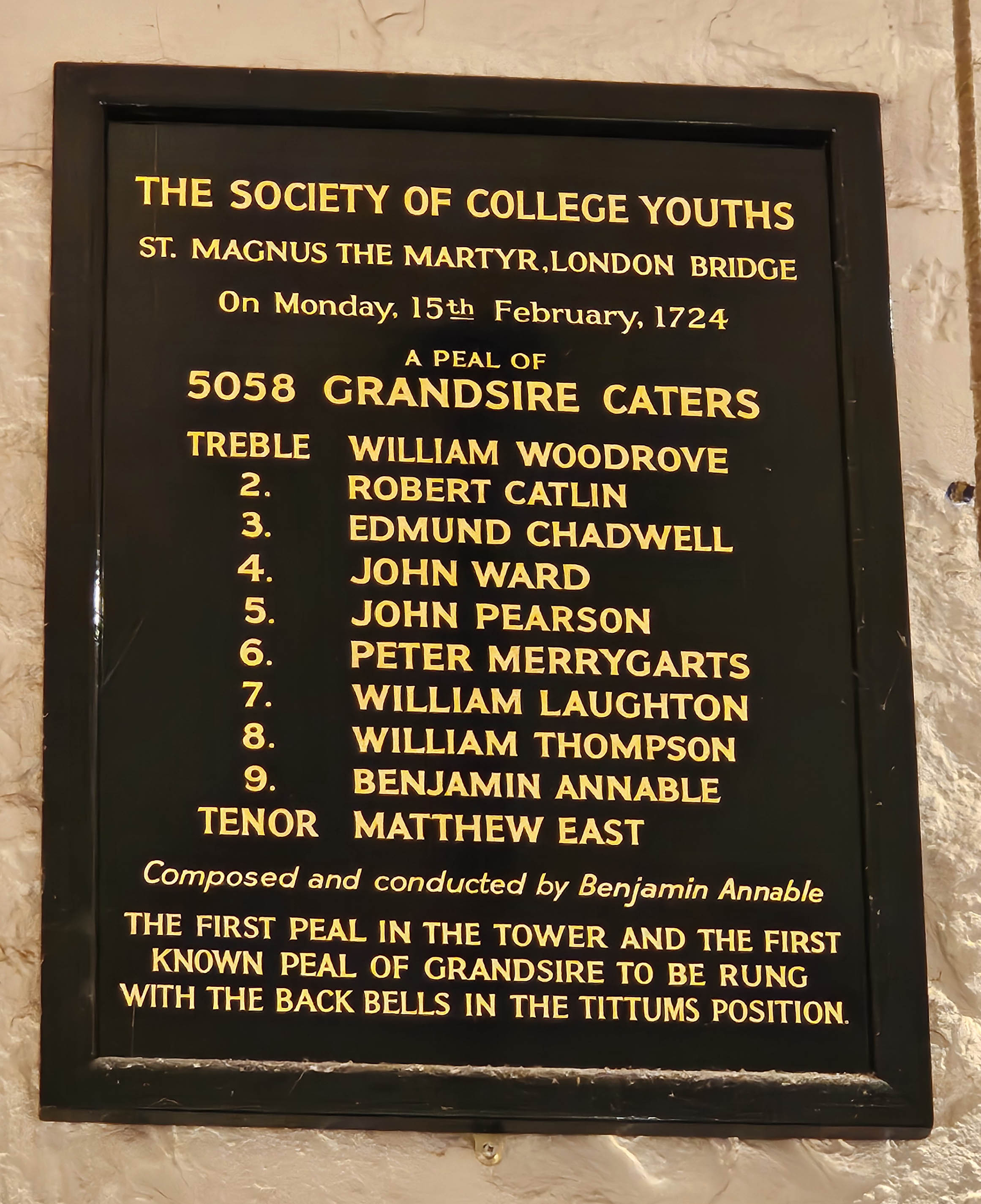
Photo: Dickon Love, 25 May 2011
| Bell | Weight (most recent) |
Diameter | Note | Date | Founder | Canons | Retuned | ||
|---|---|---|---|---|---|---|---|---|---|
| ® | Treble | Michael | 5-1-13 | 26⁷⁄₁₆" | A | 2008 | Whitechapel Bell Foundry | Never | |
| ® | 2 | Margaret | 5-2-14 | 27¼" | G | 2008 | Whitechapel Bell Foundry | Never | |
| ® | 3 | Thomas | 5-3-7 | 28" | F♯ | 2008 | Whitechapel Bell Foundry | Never | |
| ® | 4 | Maria | 5-3-8 | 29⅛" | E | 2008 | Whitechapel Bell Foundry | Never | |
| ® | 5 | Cedd | 6-0-3 | 30½" | D | 2008 | Whitechapel Bell Foundry | Never | |
| ® | 6 | Edward | 6-0-21 | 30⅞" | C♯ | 2008 | Whitechapel Bell Foundry | Never | |
| ® | 7 | Dunstan | 7-0-7 | 33⅛" | B | 2009 | Whitechapel Bell Foundry | Never | |
| ® | 8 | John | 9-0-11 | 36³⁄₁₆" | A | 2009 | Whitechapel Bell Foundry | Never | |
| ® | 9 | Erkenwald | 11-0-15 | 39⅛" | G | 2009 | Whitechapel Bell Foundry | Never | |
| ® | 10 | Paul | 13-1-26 | 41¾" | F♯ | 2008 | Whitechapel Bell Foundry | Never | |
| ® | 11 | Mellitus | 18-1-12 | 46½" | E | 2008 | Whitechapel Bell Foundry | Never | |
| ® | Tenor | Magnus | 26-3-9 | 52½" | D | 2009 | Whitechapel Bell Foundry | Never | |
| ꓕ | Clock | 3-3-3 | 25½" | F♯ | 1845 | Charles & George Mears, Whitechapel | Never |
® - Hung for full circle ringing
ꓕ- Hung dead
| Position | Frame | Bells | Year | Maker | Material | Truss(es) | Local Layout |
|
|---|---|---|---|---|---|---|---|---|
| Main belfry | 1 | Ring of 12 | 2009 | Whitechapel Bell Foundry | Cast iron | 8.3.A.h

|
12 | |
| Cupola | 2 | Service bell |


| Bell | Weight (most recent) |
Diameter | Note | Date | Founder | Retuned | Fate | |
|---|---|---|---|---|---|---|---|---|
| Treble | 5-1-4 | 27⅝" | ♯ | 1843 | Thomas Mears II | Never | Scrapped 1976 | |
| 2 | 5-1-26 | 28⅝" | E | 1748 | Robert Catlin | Never | Scrapped 1976 | |
| 3 | 5-3-16 | 30½" | D | 1714 | Richard Phelps | Never | Scrapped 1976 | |
| 4 | 6-1-6 | 30½" | C♯ | 1714 | Richard Phelps | Never | Scrapped 1976 | |
| 5 | 7-1-26 | 34" | B | 1714 | Richard Phelps | Never | Scrapped 1976 | |
| 6 | 8-2-15 | 36½" | A | 1714 | Richard Phelps | Never | Scrapped 1976 | |
| 7 | 10-0-27 | 39½" | G | 1714 | Richard Phelps | Never | Scrapped 1976 | |
| 8 | 12-1-5 | 43½" | F♯ | 1714 | Richard Phelps | Never | Scrapped 1976 | |
| 9 | 16-0-4 | 46" | E | 1714 | Richard Phelps | Never | Scrapped 1976 | |
| Tenor | 21-1-3 | 51¼" | D | 1831 | Thomas Mears II | Never | Scrapped 1976 |
| Bell | Note | Date | Founder | Retuned | Fate | |
|---|---|---|---|---|---|---|
| Treble (of 10) | F♯ | 1714-18 | Richard Phelps | Never | Recast 1843 | |
| 2nd (of 10) | E | 1714-18 | Richard Phelps | Never | Recast 1748 | |
| Tenor (of 10) | D | 1714 | Richard Phelps | Never | Recast 1831 |
| Bell | Date | Founder | Retuned | Fate | |
|---|---|---|---|---|---|
| Treble | 1672 | William Eldridge | Never | Fate unknown. Probably recast. | |
| 2 | 1672 | William Eldridge | Never | Fate unknown. Probably recast. | |
| Tenor | 1672 | William Eldridge | Never | Fate unknown. Probably recast. | |
| Saints Bells | Unknown | Never | Recast 1843 |
| Bell | Weight (most recent) |
Date | Founder | Fate | |
|---|---|---|---|---|---|
| Treble | Unknown | ||||
| 2 | Unknown | ||||
| 3 | Unknown | ||||
| 4 | Unknown | ||||
| Tenor | 13 or 14 cwt approx. | Unknown | |||
| Clock | 8 or 9 cwt approx. | Unknown | |||
| Sanctus | 1½ cwt approx. | Unknown |
| 1638 | There was an annual contract for looking after the bells, frame and fittings, given to Robert Turner the Carpenter. There were 5 bells and a Saints bell in the tower. Recorded for 1638-40. | ||
| 1641 | 4th (of 5) bells rehung by Francis Lenrett. | ||
| 1652 | All the bells were rehung, for 19s 6d. | ||
| ❺→꙰ | 1666 | The church destroyed in the Great Fire, which itself started near the church. It also destroyed the neighbouring church of St Margaret, New Fish Street. The latter was not rebuilt and the two parishes were united. | |
| 1669 | Bell metal from the fire was recovered and weighed. The records confirm that in addition to the 5 bells, there was a Saints Bell and a Clock Bell. It appears that 47 cwt of metal was recovered from the ring of five, which might suggest a ring with a tenor of about 13 or 14 cwt. However this represents a minimum weight figure as other metal might have been lost in the first. The Saints bell was 1½ cwt is fairly typical of its type. The clock bell however was rather large at 8-9 cwt. | ||
| 1672 | 3 new bells were cast by William Eldridge of Chertsey for £33.1.0 plus the old bell metal. | ||
| 1673 | A bellframe was commissioned and made by Thomas Warner, Carpenter to hang the tenor and the Saints Bell (a 2-tier frame with the Saints bell hanging above the tenor). This frame was erected such that the bells could be rung from underneath using bellropes (which were also ordered). The work on the frame cost £38.10s. The remaining bells are assumed to have been stored in the church. | ||
| 1676 | The church was rebuilt by Wren. | ||
| 1703 | A new tower was started rising to a height of 185 feet. It was completed in 1706. The model for the steeple was probably made by 1684 (very closely based on that of St Charles Borromeo by Francis Aiguillon in Antwerp). It isn't known precisely when the tower was finished, nor what became of the freestanding bellframe. It seems likely that the 3 bells and Saints bell were transferred to the new tower. | ||
| 1713 | The tenor cracked. | ||
| New ❿ | 1714 | A ring of 8 bells was cast by Richard Phelps and hung in the tower. The bells were augmented to 10 by Phelps within a couple of years as by 1718 they were recorded as being a ten. These trebles were said to be a gift from two ringing societies, the Eastern Youths and the British Scholars. | |
| 1748 | The 2nd was recast by Robert Catlin. | ||
| 1831 | The tenor became cracked and was recast by Thomas Mears. | ||
| 1843 | The treble was said to have been "worn out" and, together with the Saints bell, were scrapped while a new treble was cast by Thomas Mears. | ||
| 1846 | A new clock bell was installed. It was provided by BR & J Moore, who had earlier bought the bell from Thomas Mears. This is the 1845 bell currently in the tower. | ||
| 1917 | Bells overhauled by Mears & Stainbank. The treble, 3rd, 4th and tenor were rehung with entirely new fittings. The 5th, 6th, 7th and 8th were lifted out and the gudgeons and bearings turned afresh and refitted. The ends of the 5th, 6th and 7th pits were strengthened with angle plates. The frame on the window side of the tenor was strengthened with ironwork, and the tenor was quarter turned. | ||
| ❿→꙰ | 1940 | The bells were removed from the tower and stored in the church lest they be destroyed in the War. The roof and ceiling of the church were damaged in the air raids, but the tower was safe, and indeed the bells would not have been damaged. | |
| 1949 | Negotiations for rehanging the bells began with Mears & Stainbank, although the church was unwilling to commit substantial sums to undertake this work. | ||
| 1951 | The bells were taken to the Whitechapel where they were found to be very heavily corroded indeed and although one or two were believed to be cracked the matter of the soundness of the bells could not be established without cleaning. At the expense of Mears & Stainbank, and with the approval of the church, the bells were removed from Whitechapel for cleaning inside and out by sand blasting after which it was clear that four of them were indeed cracked. Negotiations continued in to the early 1950s with a number of detailed proposals being submitted by Mears who, to assist the church with their financial difficulties, offered a 5-year interest free loan. | ||
| 1971 | The bells had been moved about the foundry premised as rebuilding work went on. For some of the time they were stored under railway arches in Bethnal Green. They were finally moved into the big yard at Whitechapel. | ||
| 1976 | After a long period of indecision by the church, pressure was put on them and a number of alternative and less costly schemes were proposed. The foundry also offered to assist in finding donors/sponsors to help with financing and again offered an interest free loan. All these offers were ignored. The church finally instructed the foundry to scrap the bells, which they did. The tenor was used briefly in a performance of Tchaikovsky's "1812" in the Royal Albert Hall before it followed the same fate as the other nine. The revenue from the scrapped bells went to the church with an amount deducted to settle basic insurance premiums owed for the period 1972-6. | ||
| 2008 | The first of a new ring of 12 new bells were cast for the church at Whitechapel, using Gillett & Johnston profiles. | ||
| New ⓬ | 2009 | The remaining bells were cast. They were consecrated by the Bishop of London on 3rd March 2009 in the presence of the Lord Mayor and first rung for service on Easter Day. The ringing was Dedicated on 26th October by the Archdeacon of London. |