Photo: Dickon Love, Mar 2005
♫ The 8 bells ringing Stedman Triples.(BBC "Bells on Sunday", broadcast 15 July 2012)
Details of the Bells
| Bell | Weight (most recent) |
Diameter | Note | Date | Founder | Canons | Retuned | ||
|---|---|---|---|---|---|---|---|---|---|
| ® | Treble | 3-1-11 | 24½" | G | 1953 | Mears & Stainbank, Whitechapel | Never | ||
| ® | 2 | 3-2-11 | 25⅛" | F♯ | 1953 | Mears & Stainbank, Whitechapel | Never | ||
| ® | 3 | 4-0-14 | 27" | E | 1953 | Mears & Stainbank, Whitechapel | Never | ||
| ® | 4 | 4-3-11 | 29⅜" | D | 1953 | Mears & Stainbank, Whitechapel | Never | ||
| ® | 5 | 5-1-22 | 31⅜" | C | 1953 | Mears & Stainbank, Whitechapel | Never | ||
| ® | 6 | 6-2-18 | 33" | B | 1952 | Mears & Stainbank, Whitechapel | Never | ||
| ® | 7 | 8-1-6 | 36½" | A | 1952 | Mears & Stainbank, Whitechapel | Never | ||
| ® | Tenor | 11-3-20 | 40" | G | 1972 | Whitechapel Bell Foundry | Never | ||
| ꓕ | Sanctus | 1-1-12 | 18" | C | 1953 | Mears & Stainbank, Whitechapel | Never |
® - Hung for full circle ringing
ꓕ- Hung dead
Bellframes
| Position | Frame | Bells | Year | Maker | Material | Truss(es) | Local Layout |
|
|---|---|---|---|---|---|---|---|---|
| Main belfry | 1 | Ring of 8 | 1953 | Mears & Stainbank, Whitechapel | Cast iron | 8.3.A.h

|
8.3

|
|
| Cupola | 2 | Sanctus |
Inscriptions on the Bells

How the bells are tuned

Previous tenor
| Bell | Weight (most recent) |
Diameter | Note | Date | Founder | Retuned | Fate | |
|---|---|---|---|---|---|---|---|---|
| Tenor | 11-1-1 | 40" | G | 1952 | Mears & Stainbank | Never | Recast 1972 |

Ring of 8 lost in the War
| Bell | Weight (most recent) |
Diameter | Note | Date | Founder | Retuned | Fate | |
|---|---|---|---|---|---|---|---|---|
| Treble | 3-3-27 | 25" | G | 1929 | Mears & Stainbank | Never | Destroyed 1941 | |
| 2 | 3-3-23 | 26" | F♯ | 1929 | Mears & Stainbank | Never | Destroyed 1941 | |
| 3 | 4-2-11 | 27½" | E | 1694 | James Bartlett | 1929 Mears & Stainbank | Destroyed 1941 | |
| 4 | 4-3-18 | 29" | D | 1662 | Anthony Bartlett | 1929 Mears & Stainbank | Destroyed 1941 | |
| 5 | 5-1-14 | 30⅝" | C | 1662 | Anthony Bartlett | 1929 Mears & Stainbank | Destroyed 1941 | |
| 6 | 6-3-6 | 32¾" | B | 1662 | Anthony Bartlett | 1929 Mears & Stainbank | Destroyed 1941 | |
| 7 | 8-2-22 | 36¼" | A | 1662 | Anthony Bartlett | 1929 Mears & Stainbank | Destroyed 1941 | |
| Tenor | 11-0-2 | 40" | G | 1662 | Anthony Bartlett | 1929 Mears & Stainbank. See also Ref. 1 below. | Destroyed 1941 | |
| Clock | 2 cwt approx. | 22½" | G | 1784 | Unknown | Never | Destroyed 1941 |

History
| 1552 | Record of 4 bells and a Sanctus. [1] | ||
| New ❺ | 1662 | The old bells were recast into a ring of 5 by Anthony Bartlet. | |
| 1665 | Samuel Pepys in his diary of 30 July noted "It was a sad noise to hear our bell to tell and ring so often today either for death or burials: I think five or six time". | ||
| 1666 | The bells survived the Great Fire. | ||
| ❺→❻ | 1694 | A treble was added by James Bartlet to make a ring of 6. The new bell was hung by Mr Cole who also repaired the fittings of the other bells. | |
| 1708 | Record of 6 bells in the tower. | ||
| 1714 | Record of "six large bells". | ||
| 1732 | The top stage of the tower was rebuilt, necessitating the installation of a new bellframe, completed the following year. The bells were rehung by William Cole. | ||
| 1749 | Record of the sanctus bell. [2] | ||
| 1785 | The vestry ordered on 28 March that "a new bell in the steeple for the clock, the other broke". | ||
| 1891 | The church was reopened on 30 October. | ||
| 1928 | John Taylor & Co inspected the bells, noting the diameters, frame plan and describing the fittings as "very old". | ||
| ❻→❽ | 1929 | The bells were rehung and retuned by Mears & Stainbank. They were augmented with two trebles (the gift of The Lord Wakefield of Hythe) to make eight. They were dedicated on 29th July (St Olave's Day). At the time, the back bells were described as the oldest peal available for ringing in the City of London (as St Bartholomew the Great was described as unavailable for ringing, as presumably were St Andrew Undershaft). [3] | |
| ❽→꙰ | 1941 | The church was damaged by enemy action and the bells were destroyed. Some of the metal was salvaged. | |
| 1952 | 3 stock bells were supplied for a new ring of 8 (these being the back 3). | ||
| New ❽ | 1953 | Bells 3-5 were cast for the church. In October the church ordered the two trebles, which were then also supplied. All 8 bells were hung in a new frame and first rung on Christmas Day. | |
| 1972 | The tenor had come cracked and was recast by Whitechapel. An identical inscription was put on the new bell to the old. |
| [1] | Itm ther remanyth in the Stiple iiij greate beles and a Saunce bell.' ('Edwardian Inventory, 1552) |
| [2] | ' ('Vestry minutes, 27 Mar 1749) |
| [3] | There is some ambigiuty in the reports of the weight of the tenor bell of this old ring. The Whitechapel tuning book states that the bell came out the mould at 11-1-2, with the borings given as 0-1-5, giving a final weight as 10-3-25. This is consistent with the weight that was quoted in the Ringing World peal reports at the time. However, the borings note was subsequently altered to 0-1-0, which gives a despatch weight of 11-0-2. So dear reader, take your pick! (After the bells were destroyed, 48-2-0 of metal was recovered.)' ('Note about the weight of the tenor bell) |
Literary collection
Pictures of the church

Photo:
Pictures from the belfry

The Sanctus bell in the cupola on top of the tower.
Photo: Dickon R Love, Mar 2005

Photo: Dickon R Love, Mar 2005

Photo: Dickon R Love, Mar 2005

The space above the bells.
Photo: Dickon R Love, 26 Nov 2013

View down on to the bells.
Photo: Dickon R Love, 26 Nov 2013

Photo: Dickon R Love, 26 Nov 2013

Photo: Dickon R Love, 26 Nov 2013
Pictures from the ringing room

Photo: Dickon R Love, 26 Nov 2013

Photo: Dickon R Love, 26 Nov 2013
Peal boards
Timber Performance Board dated approx. 1965
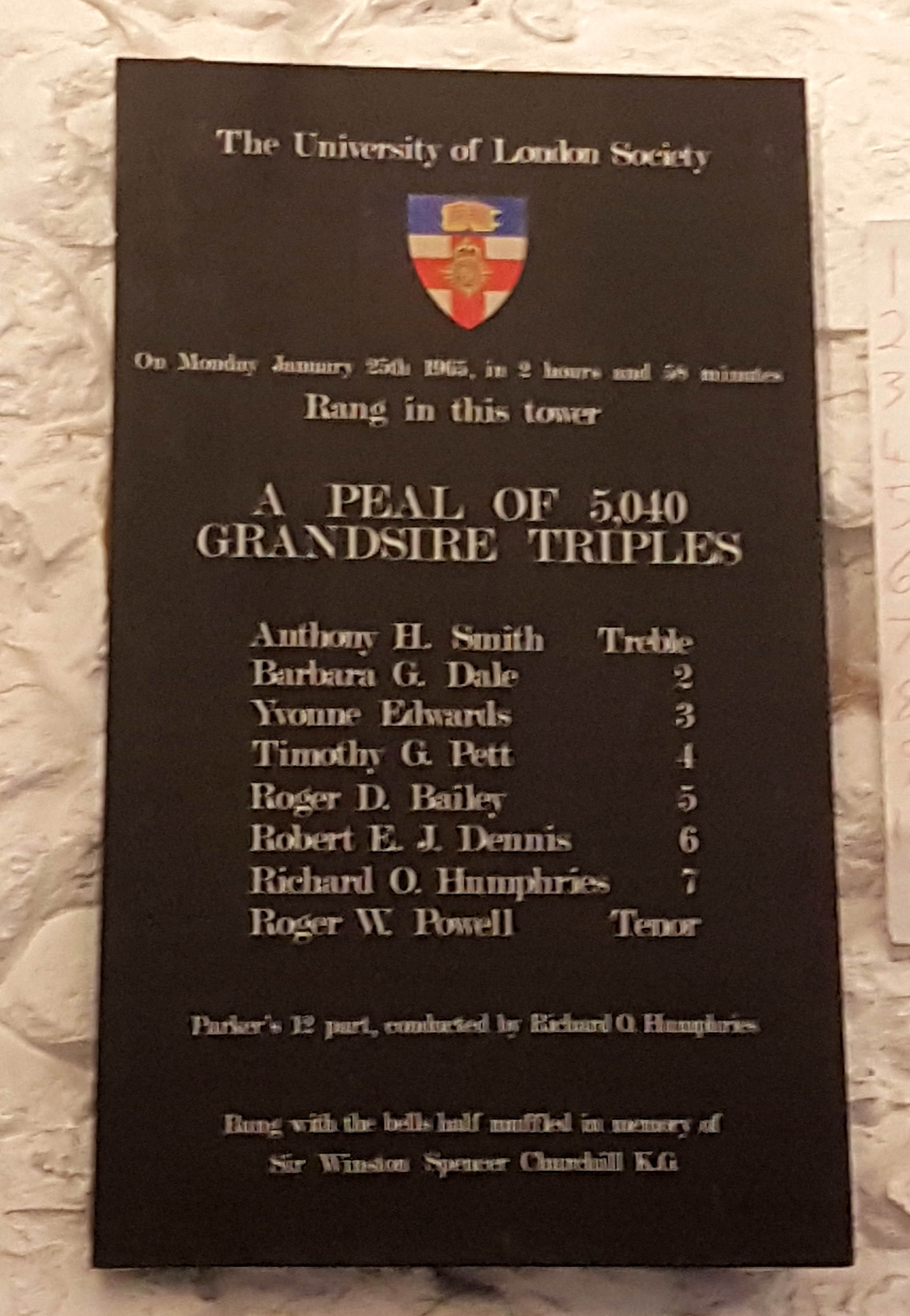
Photo: Dickon R Love, 6 August 2017
Page updated: 13 October 2019