Photo: Dickon Love, Aug 2002
| Bell | Weight (most recent) |
Diameter | Note | Date | Founder | Canons | Retuned | ||
|---|---|---|---|---|---|---|---|---|---|
| ® | Treble | 6-0-16 | 26" | G♯ | 1984 | Whitechapel Bell Foundry | Never | ||
| ® | 2 | 6-2-0 | 27" | F♯ | 1984 | Whitechapel Bell Foundry | Never | ||
| ® | 3 | 6-2-10 | 30¾" | E♯ | 1807 | Thomas Mears II, Whitechapel | 1984 Whitechapel | ||
| ® | 4 | 5-2-26 | 29¾" | D♯ | 1739 | Samuel Knight, Southwark | 1984 Whitechapel | ||
| ® | 5 | 6-2-7 | 32" | C♯ | 1739 | Samuel Knight, Southwark | 1984 Whitechapel | ||
| ® | 6 | 7-0-12 | 33" | B♯ | 1984 | Whitechapel Bell Foundry | Never | ||
| ® | 7 | 8-1-6 | 35⅞" | A♯ | 1739 | Samuel Knight, Southwark | 1984 Whitechapel | ||
| ® | 8 | 10-2-25 | 40⅜" | G♯ | 1830 | Thomas Mears II, Whitechapel | 1984 Whitechapel | ||
| ® | 9 | 12-1-22 | 42" | F♯ | 1804 | Thomas Mears I, Whitechapel | 1984 Whitechapel | ||
| ® | 10 | 13-3-15 | 43¾" | E♯ | 1739 | Samuel Knight, Southwark | 1984 Whitechapel | ||
| ® | 11 | 17-3-6 | 47⅞" | D♯ | 1739 | Samuel Knight, Southwark | 1984 Whitechapel1984 Whitechapel | ||
| ® | Tenor | 28-2-16 | 56¾" | C♯ | 1830 | Thomas Mears II, Whitechapel | |||
| ꓕ | Sanctus | 6½ cwt approx. | 27⅛" | 1698 | William Eldridge | Never |
® - Hung for full circle ringing
ꓕ- Hung dead
| Position | Frame | Bells | Year | Maker | Material | Truss(es) | Local Layout |
|
|---|---|---|---|---|---|---|---|---|
| Main belfry lower | 1 | 1,2,4,5,7,8,9,10,11,12 | 1984 | Whitechapel Bell Foundry | Cast iron | 8.3.D.a

|
||
| Main belfry upper | 2 | 3,6 | 1984 | Whitechapel Bell Foundry | Cast iron | 8.3.D.a
|
||
| Upper belfry | 3 | Empty | 1739 | Robert Catlin, Holborn | Timber | |||
| Above upper belfry frame | 4 | Sanctus | Timber |
| Bell | Date | Founder | Retuned | Fate | |
|---|---|---|---|---|---|
| Treble | Unknown | Never | Recast 1739 | ||
| 2 | Unknown | Never | Recast 1739 | ||
| 3 | Unknown | Never | Recast 1739 | ||
| 4 | Unknown | Never | Recast 1739 | ||
| 5 | Unknown | Never | Recast 1868 | ||
| Tenor | Unknown | Never | Recast 1739 |
| Bell | Date | Founder | Retuned | Fate | |
|---|---|---|---|---|---|
| Treble (of 8) | 1671 | Michael Darbie | Never | Recast 1739 | |
| 2 (of 8) | 1671 | Michael Darbie | Never | Recast 1739 |
| Bell | Date | Founder | Retuned | Fate | |
|---|---|---|---|---|---|
| Treble (of 10) | 1678 | Michael Darbie | Never | Recast 1739 | |
| 2 (of 10) | 1678 | Michael Darbie | Never | Recast 1739 |
| Bell | Date | Founder | Retuned | Fate | |
|---|---|---|---|---|---|
| 9 (of 10) | 1686 | Unknown | Never | Recast 1739 |
| Bell | Weight (most recent) |
Diameter | Date | Founder | Retuned | Fate | |
|---|---|---|---|---|---|---|---|
| Treble | 1739 | Samuel Knight | Never | Recast 1807 | |||
| 2 | 30½" | 1739 | Samuel Knight | 1984 Whitechapel Bell Foundry | |||
| 3 | 31" | 1739 | Samuel Knight | 1984 Whitechapel Bell Foundry | |||
| 4 | 32" | 1739 | Samuel Knight | Never | Recast 1984 | ||
| 5 | 35" | 1739 | Samuel Knight | 1984 Whitechapel Bell Foundry | |||
| 6 | 1739 | Samuel Knight | Never | Recast 1830 | |||
| 7 | 1739 | Samuel Knight | Never | Recast 1804 | |||
| 8 | 44" | 1739 | Samuel Knight | 1984 Whitechapel Bell Foundry | |||
| 9 | 47" | 1739 | Samuel Knight | 1984 Whitechapel Bell Foundry | |||
| Tenor | 29-2-0 | 1739 | Samuel Knight | Never | Recast 1830 |
| 1539 | On surrender of the Priory of St Bartholomew to the Crown, 6 of the 11 bells of the Priory were sold to St Sepulchre's. (The remaining 5 are still at St Bartholomew the Great.) All 11 were probably cast by Thomas Bullisdon about 1510. [1] | ||
| 1552 | Record of 6 bells and a clock bell called Baynard's Castle. [2] | ||
| 1631 | The 5th was recast at a cost of £40. [3] | ||
| ❻→꙰ | 1666 | All the bells melted in the Great Fire while enough metal to cast 3 bells was salvaged. | |
| New ❻ | 1667 | John Hodson of Bishopsgate (described in the Vestry Minutes as a carpenter) cast 6 bells and made the frame for them. | |
| 1671 | The clock & chimes were made by Mr Wyse, "The iron Barrell to be for eight bells". The churchwardens accounts show frequent amounts paid out at about this time for work on the bells, including new clappers and ropes, etc. Some of the bells appear to have been faulty. | ||
| ❻→❽ | 1677 | 2 new small bells cast, apparently by Mr Darby making 8. He could have been Michael Darbie of Southwark or John Darbie of Ipswich. | |
| 1690 | The College Youths rang the first ever touches of Grandsire Triples on the bells and claimed to have completed the first ever peal of 5040 changes (Plain Bob Triples). The absence of further details of this performance has led to this claim to be disputed. | ||
| 1695 | The tenor became cracked and was recast. | ||
| ❽→❿ | 1698 | 2 new bells cast by William Eldridge Senior of Chertsey making the ring up to 10. | |
| 1739 | All the bells except the treble were recast (the treble of this ring is still in the tower as the present Sanctus bell) by Samuel Knight. The frame was made by Robert Catlin. | ||
| 1741 | The Society of Eastern Scholars (founded 1733) rang the first ever peal of Treble Bob Royal on 7 Apr. This peal was afterwards found to be false. The College Youths went on to ring the first true peal of Treble Bob on 30 May. | ||
| 1783 | Newgate prison acquired its own bell and the great tenor was no longer rung from 6-10 am on execution mornings (though some authorities think it was rung up to the time public executions ceased in 1868). | ||
| 1804 | The 7th was recast by Thomas Mears II. | ||
| 1807 | The treble was recast by Thomas Mears II. | ||
| 1829 | The tenor fell while the Lord Mayor processed past the church on Lord Mayor’s Day. This bell weighed 29-2-0. [4] | ||
| 1830 | The tenor and 6th were recast by Thomas Mears II. The tenor weighed 31-0-4. | ||
| 1886 | One of the bells was rehung (unknown which) and the 3rd, 4th and 5th were quarter turned by John Warner & Sons. | ||
| 1905 | The bells were rehung. | ||
| 1979 | The tower was cleaned up and the bells were rung for the first time in 40 years. | ||
| ❿→⓬ | 1984 | The 4th was recast, while the remainder were tuned and rehung in a new frame together with 2 new bells to make 12. They were blessed on the floor of the church on Tuesday 14th May 1985 by the Revd Arthur Brown and commissioned in the presence of the Lord Mayor on Tuesday 11th June 1985. |
| [1] | This Church [St Bartholomew the Great], having in the Bell Tower, six Bells in a Tune, were sold to the Parish of St. Sepulchres;' ('A Survey of the Cities of London and Westminster, John Strype, 1720) |
| [2] | One great bell called banard castell, that servyth the clock, with syxe other bells in one Ryng and one santes bell' ('Edwardian Inventory, 1552) |
| [3] | An. 1631. The new casting of the fifth Bell, with the Charge of Iron, and Timber Work, to the Bell-founder, Bell-hanger, and Smith, came to 40l.' ('A Survey of the Cities of London and Westminster, John Strype, 1720) |
| [4] | CURIOUS ACCIDENT. - Yesterday afternoon, while the ten bells in the tower of St. Sepulchre’s Church, Snow-hill, were ringing a merry peal, as the Lord Mayor’s precession was passing, the tenor, or great bell, weighing 3,300 lbs. fell out of its hangings, with a most tremendous crash into the pit beneath, to the great alarm of the ringers, who were three floors under, and who were shook as if by an earthquake. The accident was caused by the gudgeons by which the bell was suspended giving way, owing to their having been worn by constant friction, for nearly two centuries. The most singular part of the accident is, that the crown and upper part of the bell are completely severed from the remaining part as if cut with a knife, notwithstanding its great thickness. The bell was remarkable for its fine sonorous tone, and for its having for many years been tolled on the morning of the execution of criminals at the Old Bailey, a practice only lately discontinued. It is now of course rendered useless, and a new tenor must be cast for the peal. No blame whatsoever attaches to the ringers, who were ringing in the most skilful manner at the time, the celebrated Whittington Change, in honour of the lord Mayor. The bell would have inevitably fallen through the floors into the rope-room, and caused the destruction of the ringers, but for the stout oaken timbers under it. As it is, the ringers consider they have had a most miraculous escape from death.' ('Standard, Tue 10 Nov 1829) |

Photo:

Here is a genuine Victorian Urinal that was used by the ringers, located behind a door into the nave roof.
Photo: Dickon R Love, 29 Mar 2003

Treble bell donated by the Ancient Society of College Youths.
Photo: Dickon R Love, 29 Mar 2003

2nd donated by William & Colin Wright.
Photo: Dickon R Love, 29 Mar 2003

The Samuel Knight 11th with interesting markings of coins, leaves, fleur de lys and flower.
Photo: Dickon R Love, 29 Mar 2003

The top tier (with the 3rd and 6th).
Photo: Dickon R Love, 29 Mar 2003

Another view of the belfry.
Photo: Dickon R Love, 29 Mar 2003

Eleanor Kippin standing on the 8th.
Photo: Dickon R Love, 29 Mar 2003

A view of the 2 tiers.
Photo: Dickon R Love, 29 Mar 2003

On the storey above the bells, the old timber frame (that formerly housed the original ring of 10) is preserved.
Photo: Dickon R Love, 29 Mar 2003

Another view of the old frame.
Photo: Dickon R Love, 29 Mar 2003

Mark Humphreys standing next to the Service Bell, hung dead in its own frame above the old timber frame. This bell was formerly the treble of the ring of 10 before it was replaced by a new bell in 1739.
Photo: Dickon R Love, 29 Mar 2003

A photo taken in the 1960s of the bells in the old frame.
Photo:

Another 1960s photo of the Sanctus bell.
Photo:

The church as it appeared then.
Photo: Stephen A Waters (now in ASCY library)

Peter Furniss and Nigel thomson surveying the scene, before starting the clean-up.
Photo: Stephen A Waters (now in ASCY library)

A bit of a mess in the ringing room.
Photo: Stephen A Waters (now in ASCY library)

General view of the ringing room.
Photo: Stephen A Waters (now in ASCY library)

Another general view.
Photo: Stephen A Waters (now in ASCY library)

The old clock in situ before removal.
Photo: Stephen A Waters (now in ASCY library)

The tenor, complete with 40 years of pigeon droppings.
Photo: Stephen A Waters (now in ASCY library)

Another view of one of the old bells.
Photo: Stephen A Waters (now in ASCY library)

Nigel Thomson, Gareth Davis and Peter Furniss about to start work removing some of the mess.
Photo: Stephen A Waters (now in ASCY library)

The Sanctus bell.
Photo: Stephen A Waters (now in ASCY library)

Gareth Davis cleaning up the tenor.
Photo: Stephen A Waters (now in ASCY library)

At the back: Peter Furniss and Chris Pickford. Front row: Nigel Thomson, Gareth Davis, Steve Waters, Stephen Ivin, Charles Brown (St Seps Treasurer), Andrew Wilby, Andrew Stubbs, Clarke Walters, Brian Threlfall and Alan Frost. Taken on Monday 23rd July 19
Photo: Stephen A Waters (now in ASCY library)

Some of the workers: Gareth Davis, Peter Furniss, Nigel Thomson, Andrew Wilby and Steve Waters.
Photo: Stephen A Waters (now in ASCY library)

Chris Pickford, Gareth Davis, Peter Furniss, Nigel Thomson, Andrew Wilby and Steve Waters.
Photo: Stephen A Waters (now in ASCY library)

Andrew Wilby and Steve Waters, taken on Monday 23rd July 1979.
Photo: Stephen A Waters (now in ASCY library)

Andrew Wilby posing on the tenor box! Approximately where the 7th is now in the new ring.
Photo: Stephen A Waters (now in ASCY library)
Timber Performance Board dated approx. 1741
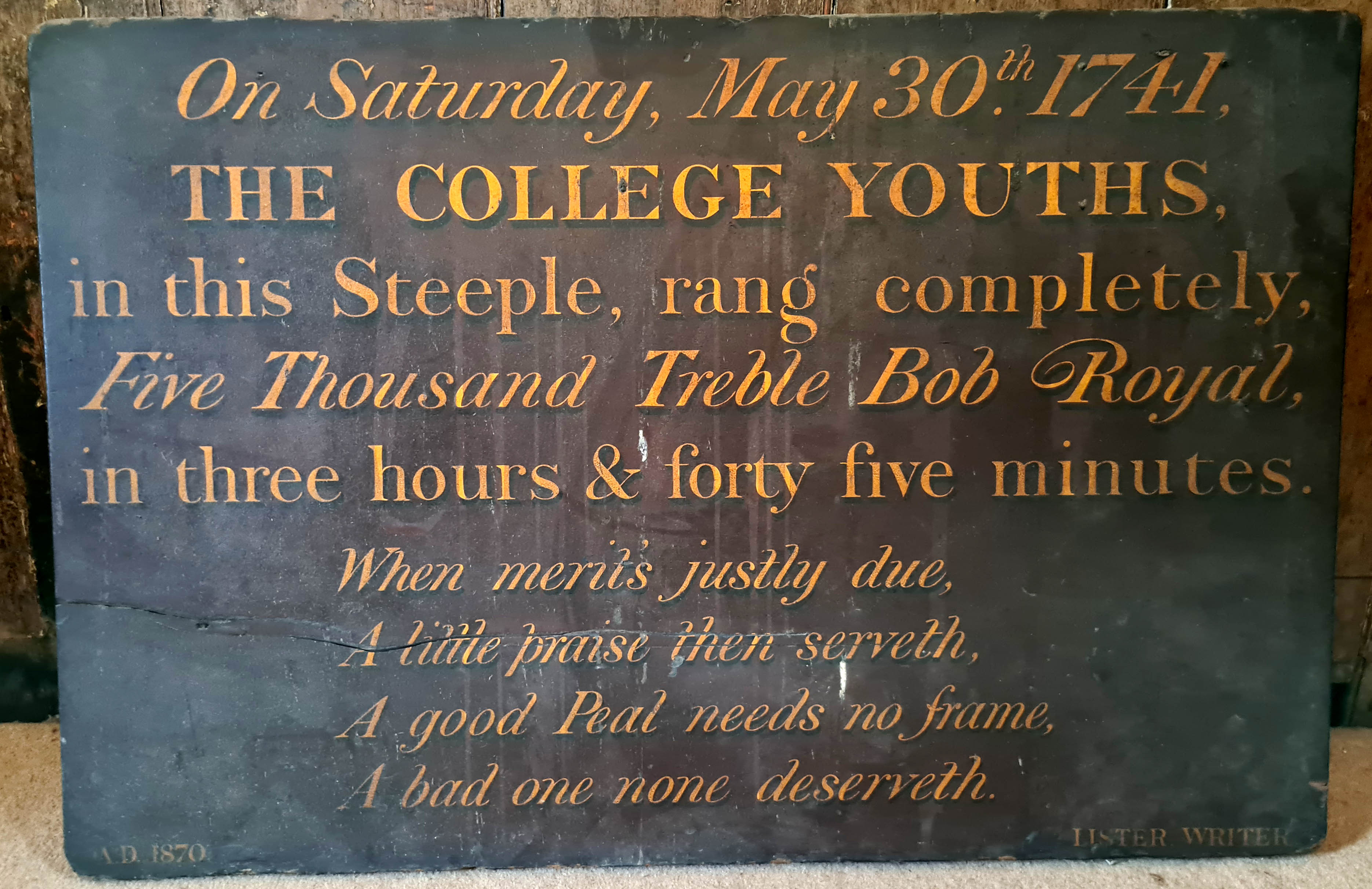
Photo: Dickon R Love, 18 June 2022
Timber Performance Board dated approx. 1794
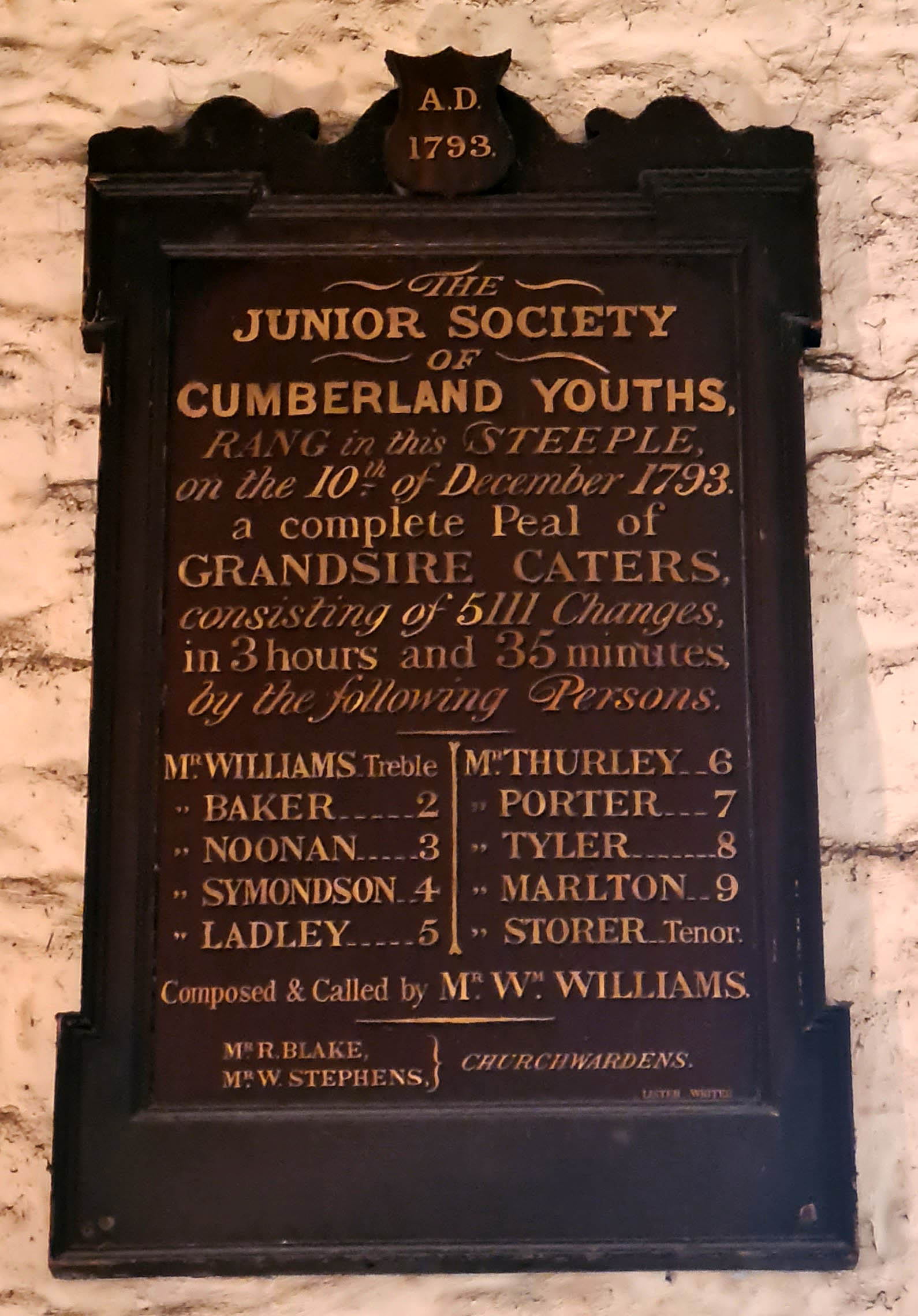
Photo: Dickon R Love, 18 June 2022
Timber Performance Board dated approx. 1857
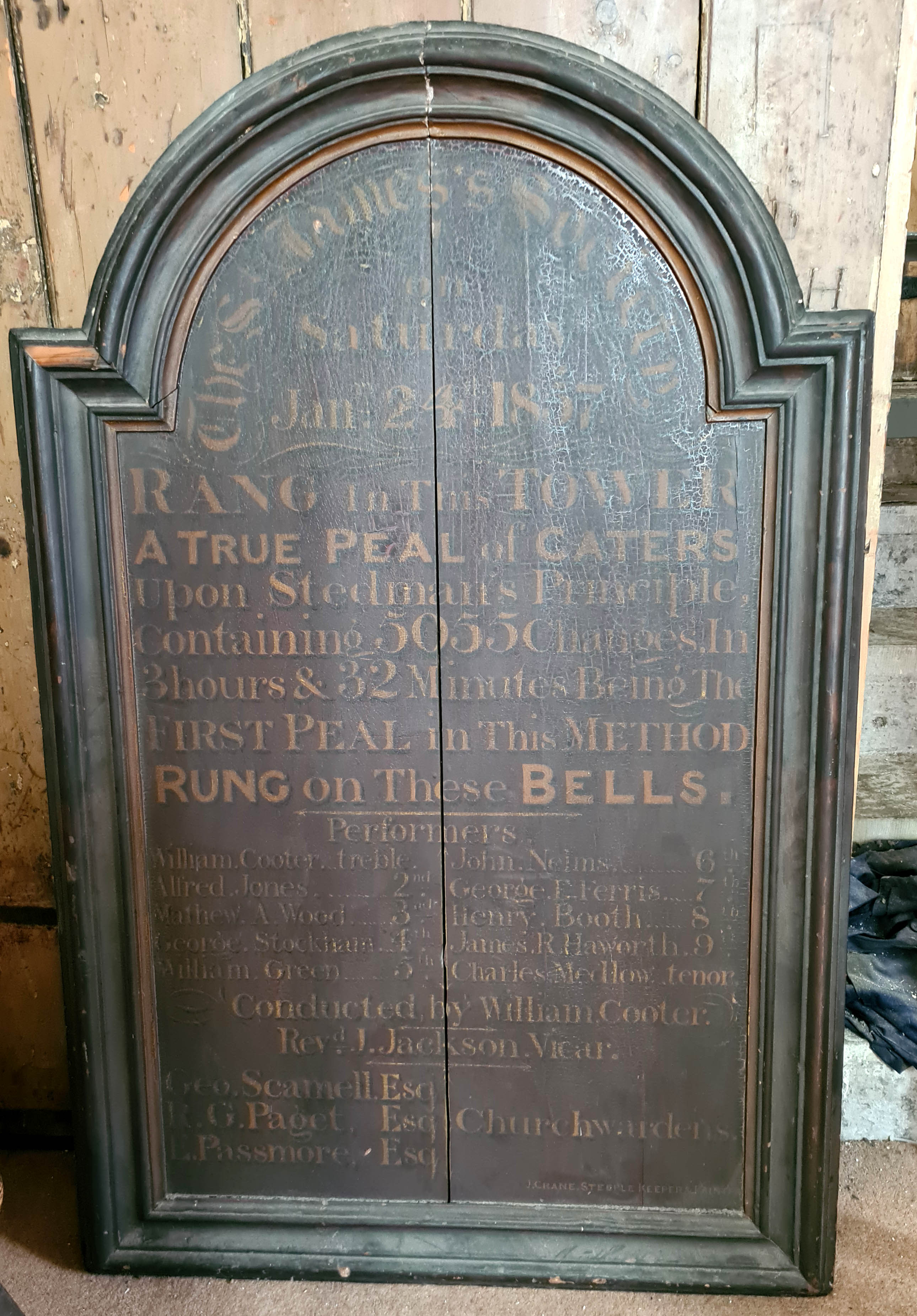
Photo: Dickon R Love, 18 June 2022
Timber Performance Board dated approx. 1869
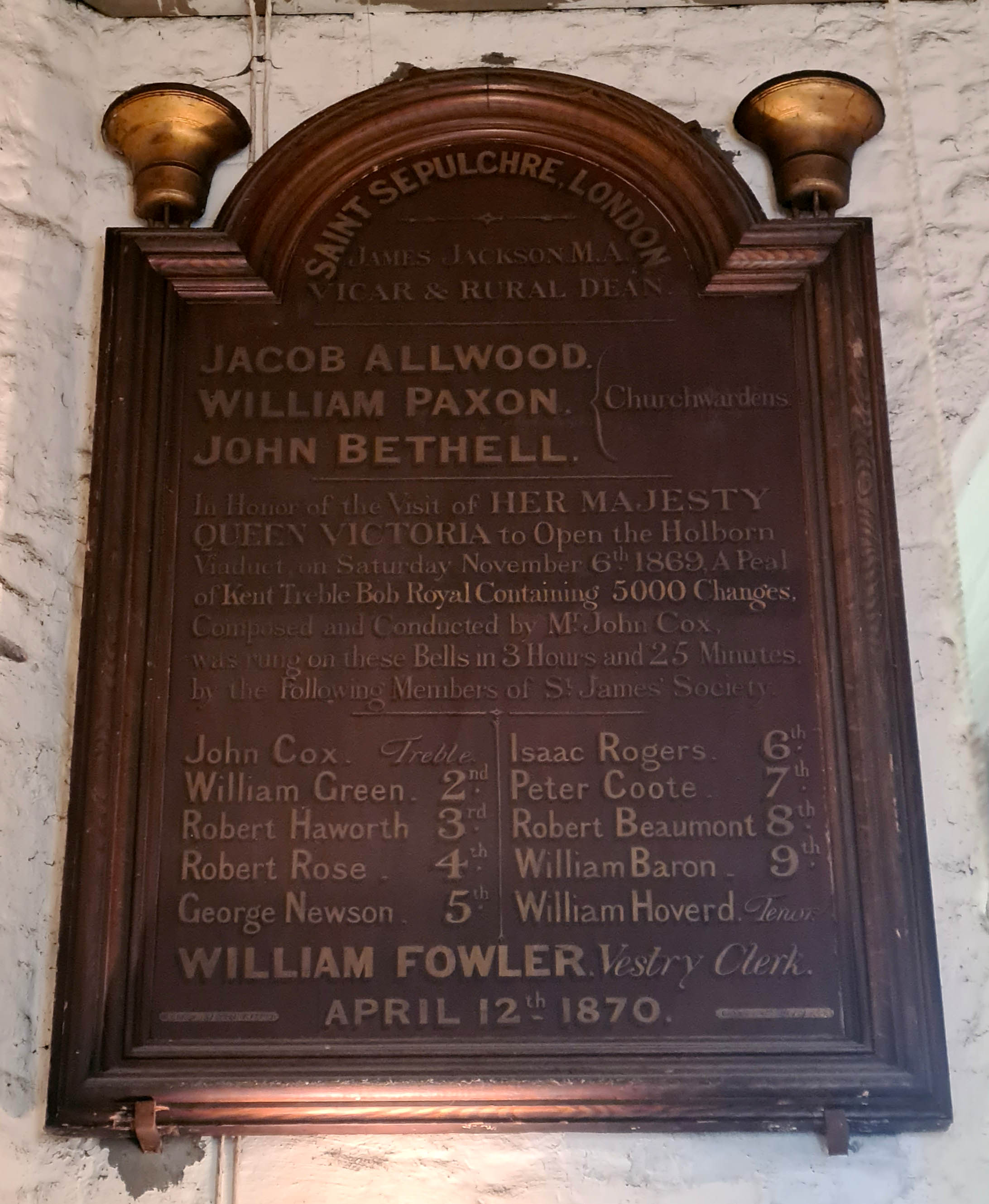
Photo: Dickon R Love, 18 June 2022
Timber Performance Board dated approx. 1880

Photo: Dickon R Love, 18 June 2022
Timber Performance Board dated approx. 1987
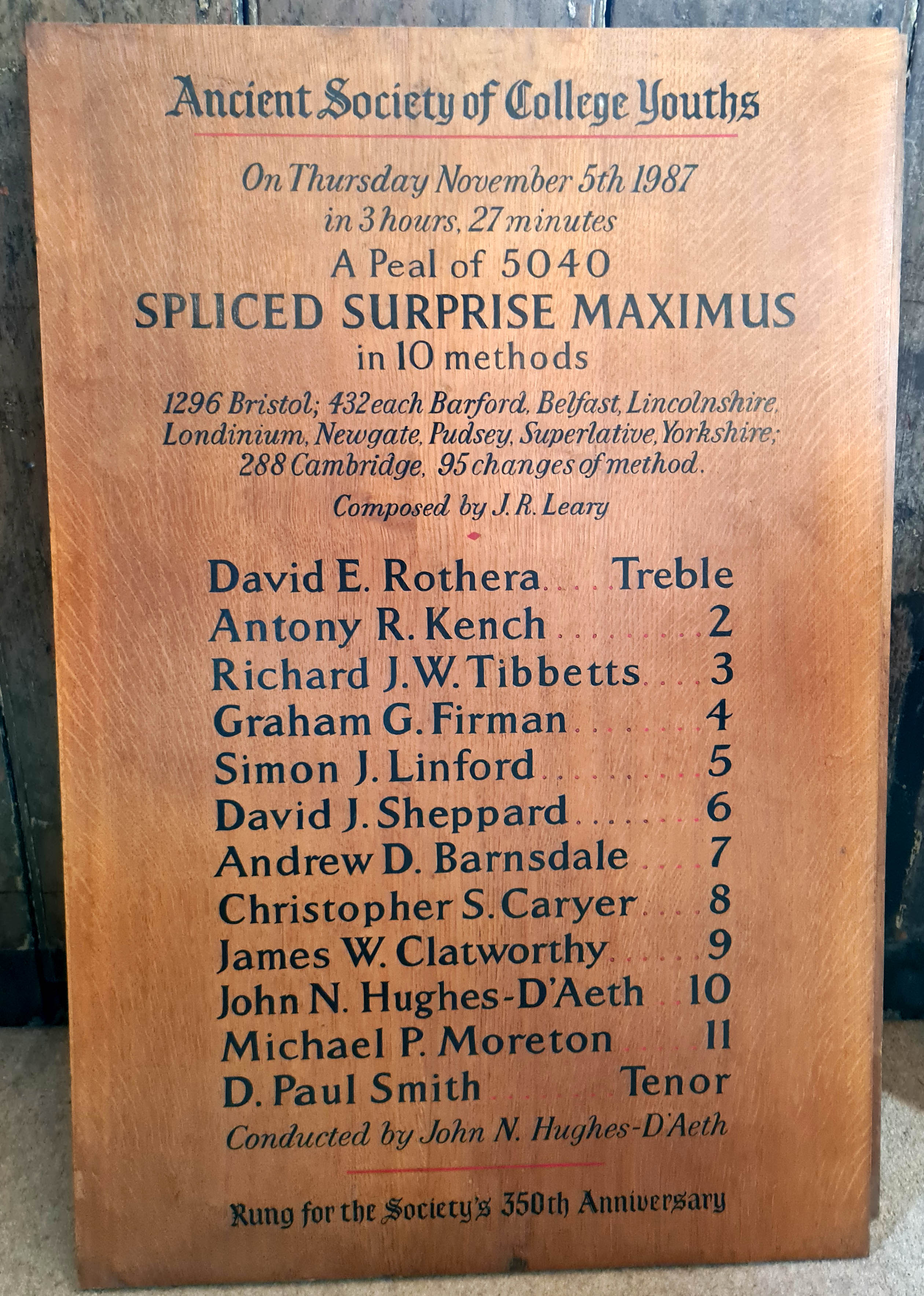
Photo: Dickon R Love, 18 June 2022
Timber Performance Board dated approx. 1987
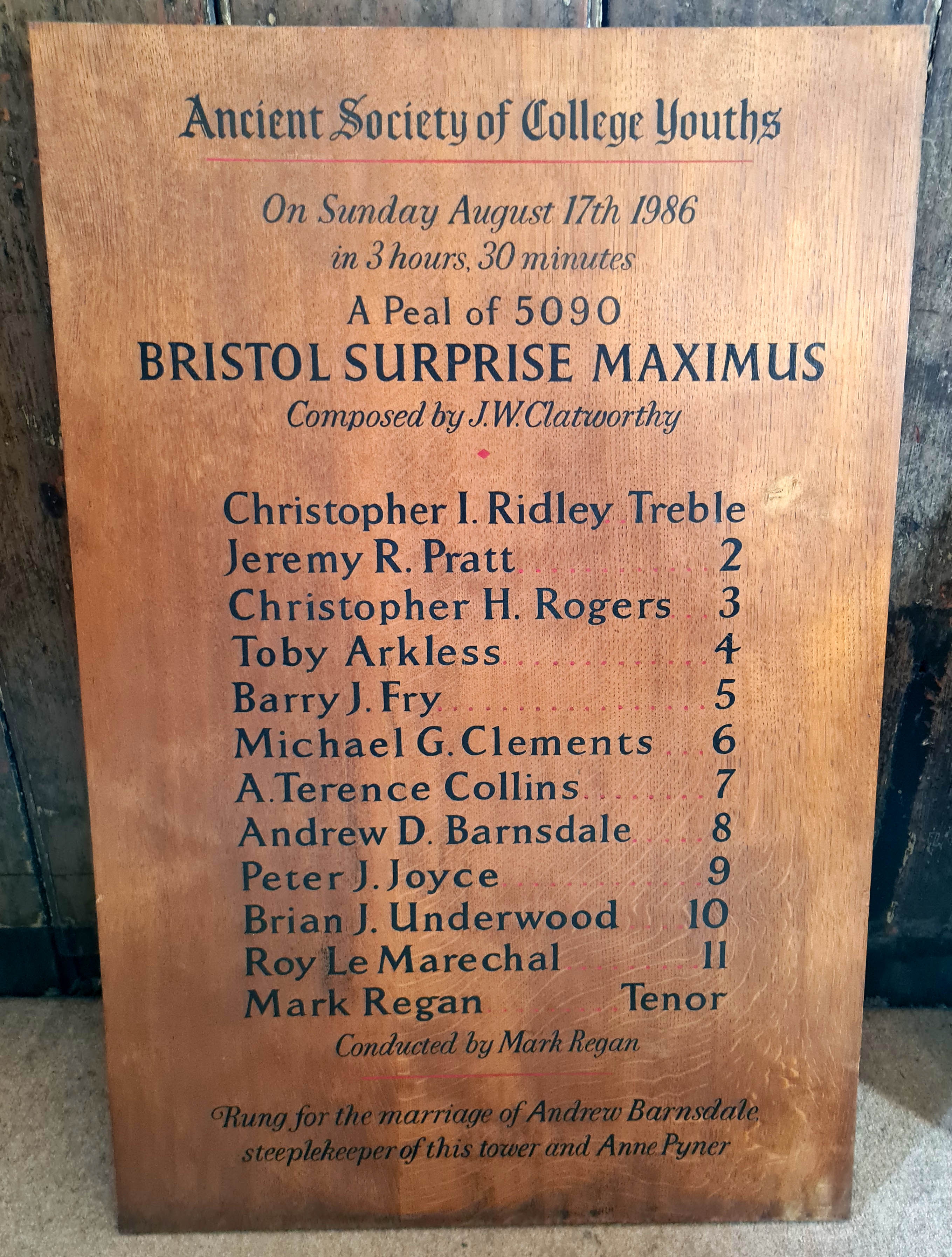
Photo: Dickon R Love, 18 June 2022
Page updated: 13 October 2019